Metric, UNC, UNF, BSPP, and NPT Thread Gauges Explained: A Practical Selection Guide
Thread gauges only work well when they match the exact thread system being inspected. That sounds obvious, but in day-to-day sourcing and inspection work, confusion between standards is still common. A buyer may know the nominal size, but not the thread form. A workshop may know the customer market, but not the tolerance class. An inspector may know the product is a pipe fitting, but not whether the thread is straight or tapered.
That is why thread gauge selection must begin with the thread standard itself. Metric, UNC, UNF, BSPP, and NPT are all widely used, but they are not interchangeable. Each one has its own thread profile, pitch convention, and application environment.
This guide explains the most common thread standards seen in industrial supply and shows how to choose the correct gauge for each.
Why Thread Standards Matter in Gauge Selection
A thread gauge is not a generic tool. It is made for a specific thread system, size, and tolerance. If any of those do not match the part, the result can be misleading.
Using the wrong standard can cause:
-
false rejection of good parts
-
acceptance of nonconforming parts
-
poor assembly in the field
-
extra time spent on troubleshooting
That is why a correct drawing review is the first step before ordering any gauge from the Gauge category.
Metric Thread Gauges
Metric threads are common in general manufacturing, tooling, and mechanical parts across many international markets. Their sizes are typically shown in millimeters, and pitch is expressed directly in millimeters as well.
Metric thread gauges are often selected when:
-
the drawing uses
Mthread callouts -
the project follows ISO metric standards
-
the parts are for global industrial or general machinery applications
Typical examples in the current catalog include metric plug and ring gauge variants such as 6H and 6G products.
UNC and UNF Thread Gauges
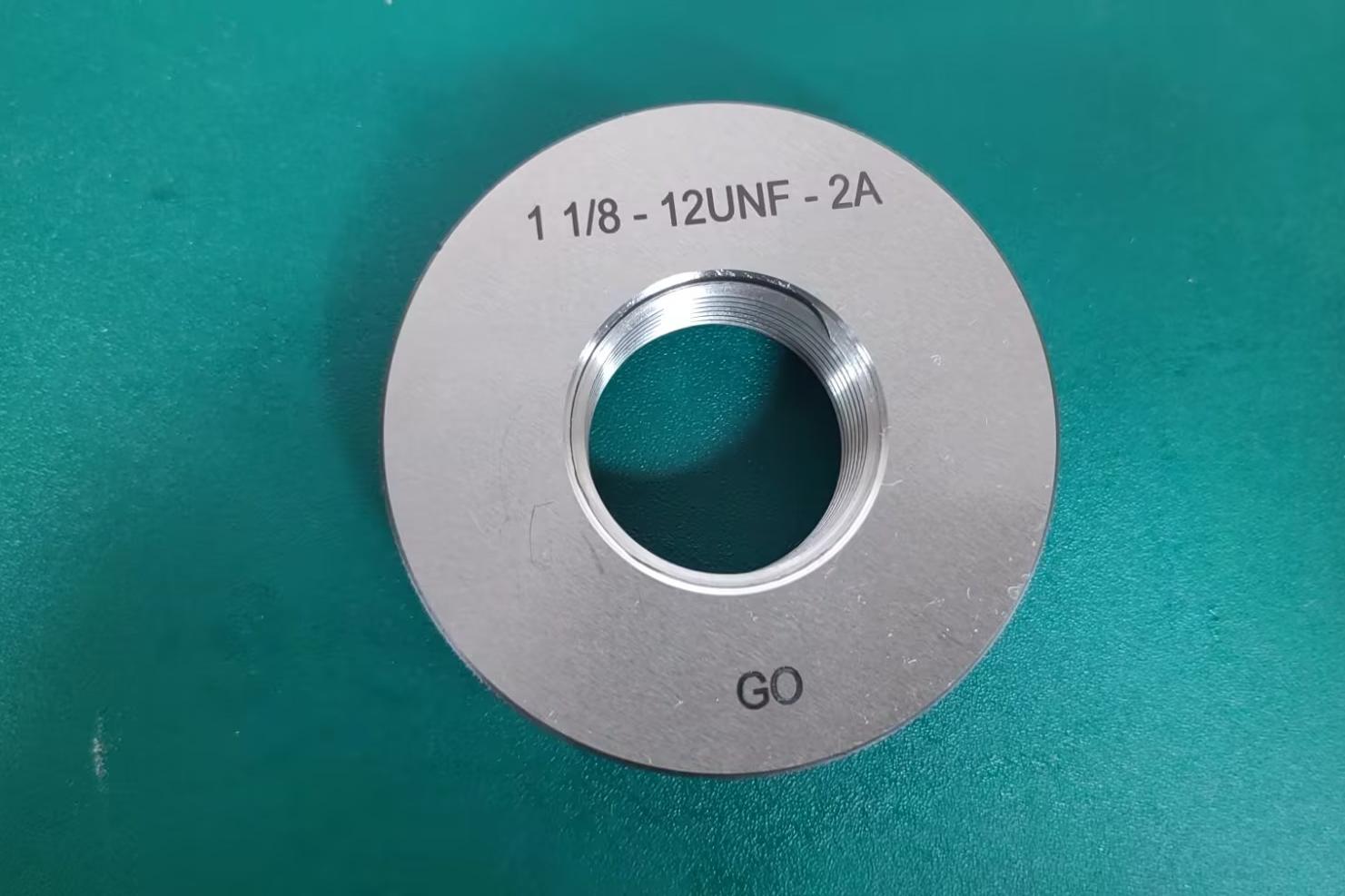
UNC and UNF are Unified thread standards commonly used in North American applications.
-
UNC means Unified National Coarse
-
UNF means Unified National Fine
UNC is often chosen where faster assembly and stronger coarse threading are preferred. UNF is often used where finer adjustment, shorter engagement, or higher vibration resistance is needed.
When choosing between them, remember that the difference is not only pitch. The gauge must also match the exact profile and designation.
Current catalog examples include:
UNEF Thread Gauges
UNEF stands for Unified National Extra Fine. This thread standard is used when even finer pitch is required than UNF, often in specialized mechanical or instrumentation applications.
UNEF gauges should only be selected when the drawing explicitly calls for UNEF. Because the pitch is finer, confusion with UNF can easily lead to incorrect ordering if the designation is read too quickly.
BSPP Thread Gauges
BSPP stands for British Standard Pipe Parallel. It is a straight pipe thread system commonly used in fluid handling and international piping connections.
The key point is that BSPP is parallel, not tapered. That matters because the sealing method and thread behavior are different from NPT.
When a part drawing or customer requirement specifies BSPP, use a BSPP gauge rather than treating it as a general pipe thread.
Example product:
NPT Thread Gauges
NPT stands for National Pipe Taper. This thread system is widely used in the United States for tapered pipe connections.
Unlike BSPP, NPT is designed with taper. That taper affects sealing and inspection. Even if two pipe threads look similar to the eye, the gauge must match the correct standard.
Example product:
BSPP vs NPT: A Common Source of Errors
BSPP and NPT are often confused because both are used in pipe or fitting applications. However, they differ in geometry and sealing behavior.
The practical rule is simple:
-
If the drawing says BSPP, use BSPP gauges.
-
If the drawing says NPT, use NPT gauges.
Do not substitute one for the other because the thread fit result will not be reliable.
How to Choose the Correct Thread Gauge
1. Start with the drawing
The thread callout usually tells you more than the nominal size. It may reveal the thread family, pitch, and tolerance class.
2. Identify whether the thread is internal or external
Use a thread plug gauge for internal threads and a thread ring gauge for external threads.
3. Match the exact standard
Metric, UNC, UNF, UNEF, BSPP, and NPT each need their own matching gauges.
4. Match the tolerance class
For unified threads, classes like 2A or 2B matter. For metric threads, classes like 6H and 6G matter. Buyers should never assume the class is interchangeable.
5. Match the application
If the parts are for hydraulic, pneumatic, automotive, or export markets, the customer standard should drive the gauge choice.
Quick Selection Logic
Use this simple logic when purchasing:
-
Choose metric gauges for ISO metric threads.
-
Choose UNC for unified coarse threads.
-
Choose UNF for unified fine threads.
-
Choose UNEF for extra fine unified threads.
-
Choose BSPP for parallel pipe threads.
-
Choose NPT for tapered pipe threads.
FAQ
Are UNC and UNF gauges interchangeable?
No. They use different pitches and must be gauged with the correct matching standard.
Can BSPP and NPT use the same gauge?
No. BSPP is parallel and NPT is tapered, so the gauges are not interchangeable.
What is the safest way to avoid thread gauge ordering mistakes?
Review the drawing carefully, confirm internal or external thread inspection, and match the exact standard and tolerance class before ordering.
Conclusion
Selecting a thread gauge becomes much easier when the standard is clear. Metric, UNC, UNF, UNEF, BSPP, and NPT all serve real industrial needs, but each requires the correct matching gauge to produce reliable inspection results.
For sourcing teams and inspectors, the best habit is to slow down at the specification stage. Confirm the thread family, then confirm the gauge type, then confirm the tolerance class. That sequence prevents most ordering errors and supports smoother production inspection.