Coating Thickness Gauge Explained: Fe/NFe Measurement, Accuracy, and Common Uses
Coating thickness matters in more industries than many buyers first expect. It affects corrosion protection, finish quality, inspection compliance, and long-term product performance. Whether the coating is paint, plating, or another protective layer, too little thickness can reduce durability, while too much thickness can affect tolerance, appearance, or process cost.
A coating thickness gauge gives inspectors a fast way to check that coating builds are within the expected range. It is widely used in manufacturing, finishing, maintenance, and incoming quality inspection.
This guide explains what a coating thickness gauge measures, what Fe and NFe mean, how the measurement works, and what buyers should check before ordering one.
What a Coating Thickness Gauge Measures
A coating thickness gauge measures the thickness of a coating layer applied over a base material. Common examples include:
-
paint on metal parts
-
plated coatings
-
powder coatings
-
protective industrial surface finishes
The goal is usually to verify whether the coating thickness falls inside a required range rather than simply to record a number for reference.
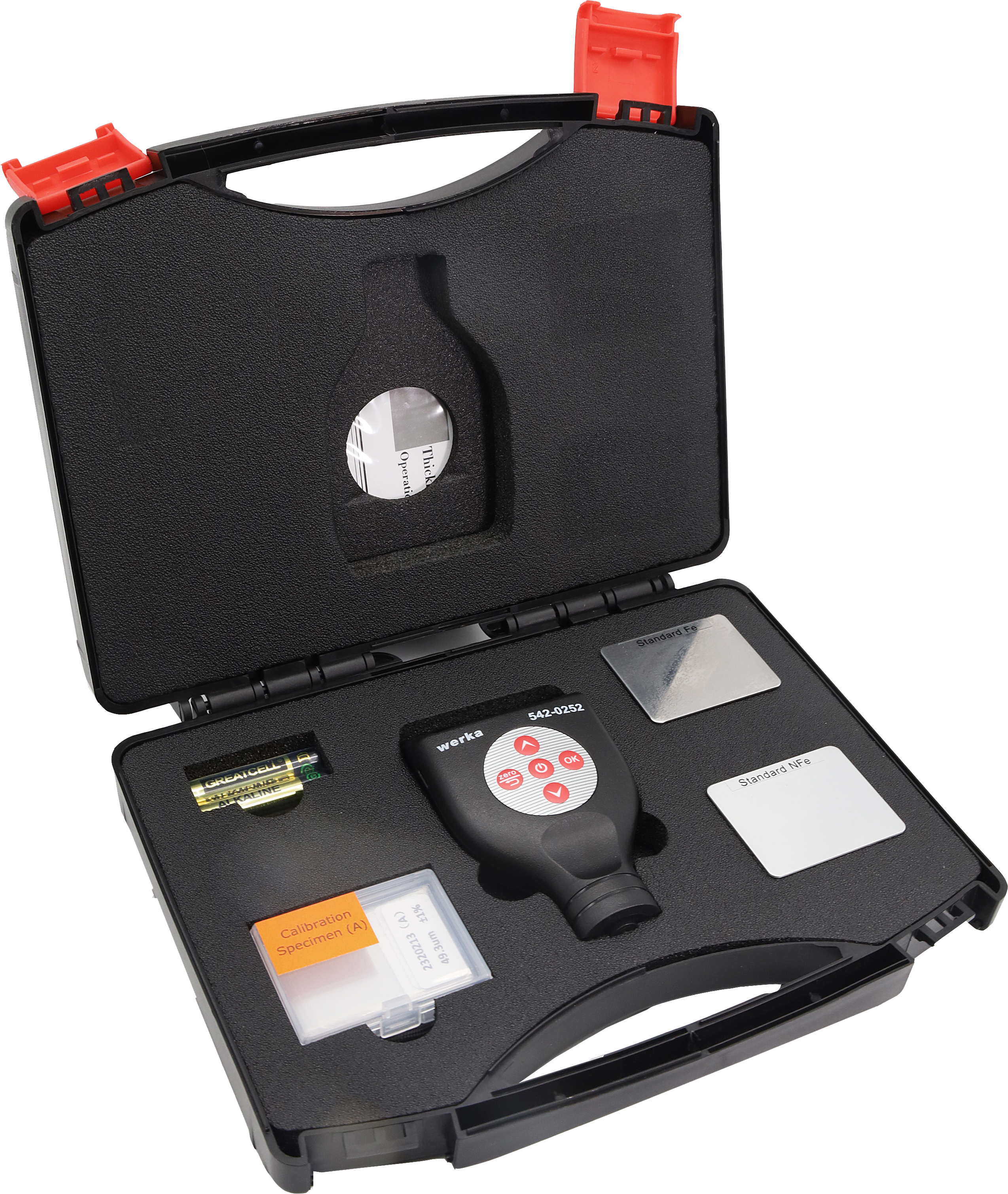
On the current site, this product family appears under the Thickness Gauge category, including the Coating Thickness Gauge 0-1500um | Fe/NFe Digital Paint Thickness Tester.
What Fe and NFe Mean
One of the most important terms in coating thickness measurement is Fe/NFe.
-
Fe refers to ferrous substrates, usually steel or iron-based materials.
-
NFe refers to non-ferrous substrates, such as aluminum and some other non-magnetic metals.
This matters because the measurement principle changes depending on the substrate type. A gauge that supports both Fe and NFe is more flexible for users inspecting different materials.
How a Coating Thickness Gauge Works
At a practical level, coating thickness gauges usually rely on different physical principles for ferrous and non-ferrous materials.
On ferrous substrates
Measurement is commonly based on magnetic induction.
On non-ferrous substrates
Measurement is commonly based on eddy current principles.
The operator does not always need to understand all the underlying physics in detail, but it is important to know that substrate material affects how the reading is generated.
Why Accuracy Depends on More Than the Gauge
Buyers often focus on the stated accuracy value, but real-world coating measurement is influenced by several factors:
-
substrate material
-
surface roughness
-
curvature of the part
-
coating condition
-
calibration practice
-
correct probe contact
That is why repeatable technique matters almost as much as the instrument specification.
Common Uses of a Coating Thickness Gauge
Typical applications include:
-
paint thickness inspection
-
plating quality control
-
incoming inspection of coated parts
-
maintenance and service checks
-
automotive and industrial finishing review
In many of these environments, the coating thickness gauge is valued because it provides fast, non-destructive inspection.
How to Use a Coating Thickness Gauge More Reliably
1. Confirm the substrate material
Know whether the part is Fe or NFe before measuring. This helps ensure the correct measurement mode is used.
2. Check calibration practice
Measurement confidence improves when the gauge is checked against known references or calibration foils according to normal quality procedures.
3. Measure on a suitable surface
Edges, sharp curvature, and rough areas can influence the result. When possible, measure on representative, stable areas.
4. Repeat at several points
Coating thickness can vary across one part. Multiple readings often provide a better picture than a single spot measurement.
How to Choose the Right Coating Thickness Gauge
When purchasing, consider:
-
Fe only or Fe/NFe capability
-
measuring range
-
display readability
-
portability
-
production versus field inspection use
-
expected calibration and reporting practice
A user inspecting only steel parts may prioritize differently from a buyer working across mixed material products.
Common Mistakes to Avoid
Measuring without checking substrate type
This can create confusion even when the instrument itself is functioning correctly.
Treating one point as the whole result
Coating distribution may vary, so multiple measurements are usually safer.
Ignoring surface condition
Roughness, dirt, or curved surfaces can affect the reading.
Choosing only by range
Range matters, but readability, portability, and dual Fe/NFe capability can be just as important.
FAQ
What is a coating thickness gauge used for?
A coating thickness gauge is used to measure the thickness of paint, plating, or other coatings on a substrate without damaging the part.
What does Fe/NFe mean on a thickness gauge?
Fe means ferrous substrates such as steel, and NFe means non-ferrous substrates such as aluminum.
Is a coating thickness gauge only for paint?
No. It can also be used for other coating layers, depending on the material system and gauge design.
Conclusion
A coating thickness gauge is a practical inspection tool for users who need fast, non-destructive confirmation of surface coating quality. Understanding Fe and NFe is a key part of selecting and using the tool correctly, because substrate type directly affects measurement method.
For buyers, the smartest choice is usually the one that fits the real inspection environment: material type, required range, operator workflow, and calibration practice. Once those factors are clear, choosing the right thickness gauge becomes much easier.